
5 RFID pilot project mistakes
When a company decides to test RFID through a pilot project, the tendency is to treat this phase as a straightforward technical trial. In reality, how the pilot is designed and executed largely determines the success of large-scale implementation.
A poorly designed pilot project is worse than no pilot at all. It creates the false impression that the system is working correctly, only for the real problems to surface during the production rollout — when the cost of intervention is significantly higher.
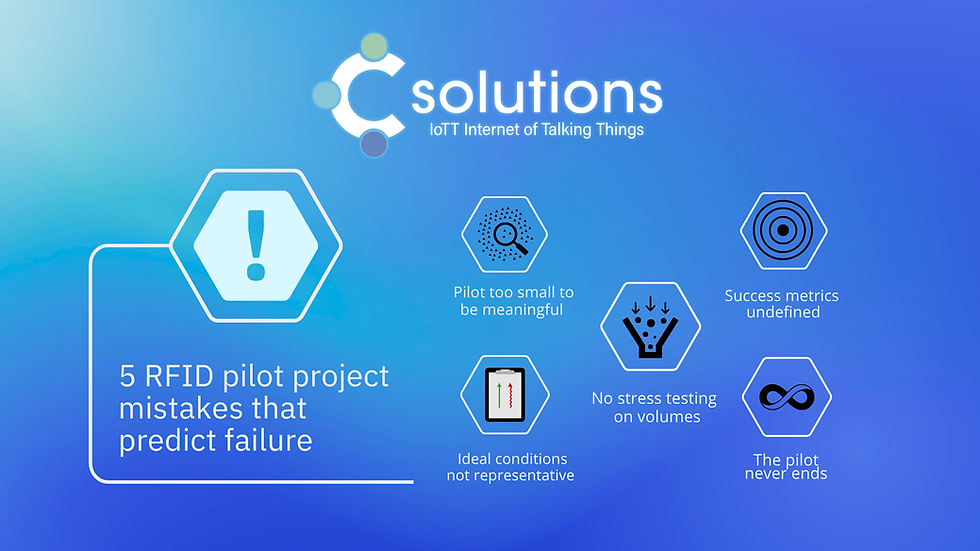
In our experience, we have identified five recurring mistakes that undermine the value of the pilot project and lead to wrong decisions about system scalability.
Mistake 1: Insufficient Scale
Testing 50 tags to validate a system that will use 50,000 does not generate reliable evidence. RFID system behaviour changes significantly when moving from small-scale testing to real production volumes. Tag density in the environment, electromagnetic interference, processing times in the management software: all these variables behave differently under load.
A meaningful pilot must replicate the real volumes expected at full operation, using the actual product types and containers used in production. Only at this scale do system behaviours emerge that will determine the success of the deployment.
Mistake 2: Ideal conditions that do not reflect reality
Testing only on the easiest products to track and then deploying on difficult-to-read items is one of the most costly mistakes made in RFID projects. Metal or liquid content in products, reflective surfaces, metallic containers: these conditions can drastically reduce reading accuracy compared to what was observed during testing.
A well-designed pilot deliberately includes the most challenging cases: products with metallic surfaces, liquid containers, random tag orientations, variability in reading distances. The goal is not to demonstrate that the system works under optimal conditions. It is to discover where and why it does not work, in order to intervene before large-scale deployment.
Raffaele Cinaglia, CEO of Csolutions, notes: "In the C-Lab we always replicate the client's most critical operating conditions, not the most favourable ones. If the system passes testing under difficult conditions, it will be reliable under normal ones too."
Mistake 3: No stress testing at volume
A system that handles ten items per minute may fail at one hundred. Bottlenecks only emerge under real load, which in industrial production is always variable and can deviate significantly from the theoretical load assumed during the design phase.
Stress testing must simulate the volume peaks expected under real operating conditions: end of shift, production changeovers, peak seasonal periods. These are precisely the moments when an undersized system reveals its weaknesses — and also the moments when the consequences of a failure are most severe.
Mistake 4: Success metrics not defined before testing
To validate an experiment, acceptance criteria must be defined first. "Seems to be working" is not a metric. An RFID pilot must have numerical targets defined before it begins: minimum percentage of correct readings, maximum processing time per cycle, acceptable error rate, management system response time.
Without these definitions, pilot evaluation becomes subjective. Everyone interprets results according to their own expectations, making it impossible to take a data-driven decision on moving to the next phase.
Paola Barletta, Business Developer at Csolutions, adds: "We always define the acceptance metrics with the client before starting the pilot. Not after seeing the results. This avoids disagreements over what the data means and allows clear decisions to be made: the system has met the acceptance criteria, we proceed with deployment. It has not met them, we adjust the configuration and repeat the test."
Mistake 5: The Pilot Remains in Testing Indefinitely
When project ownership is not clearly assigned to a specific person or business function, the risk is that the pilot remains in a perpetual testing state. No one takes responsibility for declaring it ready for production deployment. Every new issue that emerges during testing becomes a reason to delay, even when the system has already demonstrated it meets the acceptance criteria.
This scenario carries a double cost: the direct cost of deployment delays and the opportunity cost of not having the system operational in production. To prevent this, the pilot must have a defined deadline, an identified project owner, and a clear decision-making process for moving to the next phase.
How to structure a pilot that generates real evidence
An effective pilot project does not come from improvisation. It requires a design phase that precedes hardware installation and defines: the scope of the test (which processes, which products, which volumes), the conditions to replicate (including the most critical ones), acceptance metrics, the activity schedule, and decision-making ownership.
In our approach, the C-Lab validation phase always precedes the pilot project on-site. In the laboratory, we replicate the client's operating conditions, test hardware and software configurations, and optimise the system until it reaches 99.5% reading reliability. Only at that point is the system ready for testing under real production conditions.
This reduces the risk of the on-site pilot: the question is no longer whether the system works, but whether it performs under real operating conditions after its functionality in controlled conditions has already been verified.
Frequently Asked Questions(FAQ)
How long should an RFID pilot project last?
The duration depends on process complexity and the variability of operating conditions. A pilot in a production environment with standardised processes can be completed in four to six weeks. More complex environments, or those with high seasonal variability, require a longer duration to collect representative data.
Who should be involved in the pilot project?
The pilot must involve the production or warehouse manager (for operational validation), the IT manager (to verify integration with existing systems), and management (to validate business metrics). Limiting the pilot to the technical team alone produces incomplete evidence.
Does the C-Lab replace the on-site pilot project?
No, they are two complementary phases. The C-Lab resolves technical variables under controlled conditions. The on-site pilot validates the system under real operating conditions, with the specific products, volumes, and dynamics of that production environment.
Contact us to structure an RFID pilot project with defined acceptance criteria and C-Lab validation.


Comments